Robert Edward Barnes
Robert Edward Barnes’ Personal Narrative was derived from information found in public records, military personnel files, and local/state historical association materials. Please note that the Robb Centre never fully closes the book on our servicemembers; as new information becomes available, narratives will be updated to appropriately represent the life story of each veteran.
Please contact the Robb Centre for further clarification or questions regarding content or materials.
Military Honor(s):
Distinguished Service Cross 6 December 1918
Citation: The President of the United States of America, authorized by Act of Congress, July 9, 1918, takes pleasure in presenting the Distinguished Service Cross to Sergeant Robert Barnes (ASN: 1403375), United States Army, for extraordinary heroism in action while serving with Company L, 370th Infantry Regiment, 93d Division, A.E.F., near Mont de Singes, France, 19 September 1918. After starting on a mission to reconnoiter the front lines of the enemy, Sergeant Barnes received wounds which proved serious. Disregarding advice to return, he continued collecting valuable information, which was submitted to his company commander through a member of his patrol party.
Life & Service
- Birth: 9 October 1892, Greencastle, IN, United States
- Place of Residence: Danville, IL, United States
- Race/Ethnicity: African American
- Death: 27 April 1943 Chicago, IL, United States
- Branch: French 59th Division, French 10th Army, French XXX Corps Army
- Military Rank: Sergeant
- Company: [L]
- Infantry Regiment: 370th
- Division: 93rd
Personal Narrative
Early Life (Pre-War): Includes general parent information, sibling information, education
Robert Barnes was born to George E. (1860-1915) and Josie Halford (1870-1926) on 9 October, 1892, in Greencastle, Indiana, the eldest to sisters Ethel (1895-1947) and Ada (1897-1929). George and Josie divorced sometime between 1900 and 1910, Josie later married Edward Case.
Service: Includes a summary of transfers, rank change(s), training, enlistment, and discharge locations
Robert Barnes enlisted in the 8th Illinois National Guard on 19 July, 1915 in Danville, Illinois, and was later mustered into federal service with Co. L., 370th Infantry Regiment, 93rd Division, A.E.F. Robert was made a Corporal on 29 July, 1916, and later a Sergeant on 26 February, 1918. Sergeant Barnes and his company left Newport News, Virginia on 7 April, 1918 on the US Army Transport ship President Grant, arriving in Brest, France on 14 April, 1918. Robert was wounded in action on 21 September, 1918; he was treated in French hospitals from 21 September, 1918-8 October, 1918; in Camp Hospital #52 A.E.F. from 8 October, 1918-24 November, 1918; in Base Hospital #27 A.E.F. from 24 November, 1918-20 December, 1918; and finally, in Base Hospital #8 A.E.F. from 20 December, 1918-10 January, 1919. Barnes received the Distinguished Service Cross for his actions near Mont de Singes, France, on 19 September, 1918;
“The Distinguished Service Cross is presented to Robert Barnes, Sergeant, U.S. Army, for extraordinary heroism in action near Mont de Singes, France, September 19, 1918. After starting on a mission to reconnoiter the front lines of the enemy, Sergeant Barnes received wounds which proved serious. Disregarding advice to return, he continued collecting valuable information, which was submitted to his company commander through a member of his patrol party.” Awarded DSC by CG, AEF, December 6, 1918. Published in G.O. No. 37, W.D., 1919.
“Sergeant Barnes was in command of a reconnoitering group with instructions to obtain information of the enemy’s front lines. Shortly after starting on this mission he was shot in the right side, a wound which later developed to be quite serious. Notwithstanding that he was advised by the rest of the members of the patrol to return, he refused and continued on his mission obtaining the desired information which he transmitted to his company commander by a member of his patrol, and not until then did he apply for attention at the dressing station. Note: All members of his patrol have since been evacuated for wounds received in action, and it is impossible to locate their whereabouts at this time. Appended hereto is certificate of his company commander under whose orders he was acting at the time.”
Sergeant Barnes and his company left for the United States on 22 January, 1919 on the US Army Transport Ship Manchuria, where they were then forwarded to Fox Hill, S.I., New York. Robert was Honorably discharged 28 April, 1919 at General Hospital #32 in Chicago, Illinois.
Sergeant Robert Barnes served with Company [L], 370th Infantry Regiment, formerly the 8th Illinois National Guard Regiment. At the time of his act of valor, his regiment was a part of the French 59th Division under the command of the French 10th Army. This is his story.
Mont de Singes – 19 September 1918

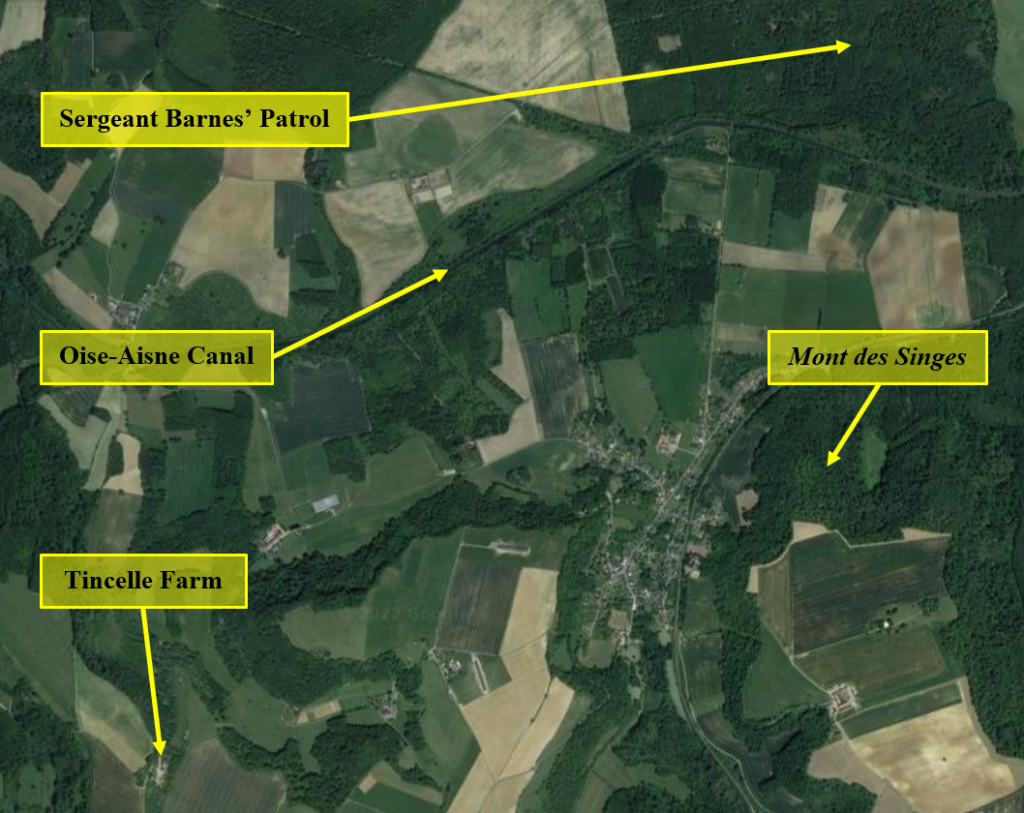
19 September 1918:
When the French 59th Division (370th Infantry Regiment attached) relieved the French 17th Division on 17 September, 1918, they found a sector in ruins. The wooded hills and valleys around the town of Vauxailon had been ruined by years of harsh artillery fire. Branches, stripped bare by rolling barrage after rolling barrage, reached like withered hands up to the heavens. Craters pockmarked the landscape, collecting foul-smelling fluids – a mix of water, toxic vapors, and putrescence – in their depths. The bones and bodies of the dead laid to rest littered the landscape, having been unceremoniously torn from their slumber when exploding shells sent great plumes of earth skyward. The living, meanwhile, were forced to bury themselves in caves and dugouts while they slept, for those who lingered in the open soon found themselves among the dead. Facing the 59th Division, the Germans had established a powerful defensive position atop the Mont des Singes, which they had already used to batter the French 17th Division to pulp. These conditions did not phase the veteran French Infantry, for they had already borne witness to four years of horror in the Great War. The French 59th Division was confident that they could take this bastion, and assumed an aggressive disposition almost as soon as they had taken control of the front.
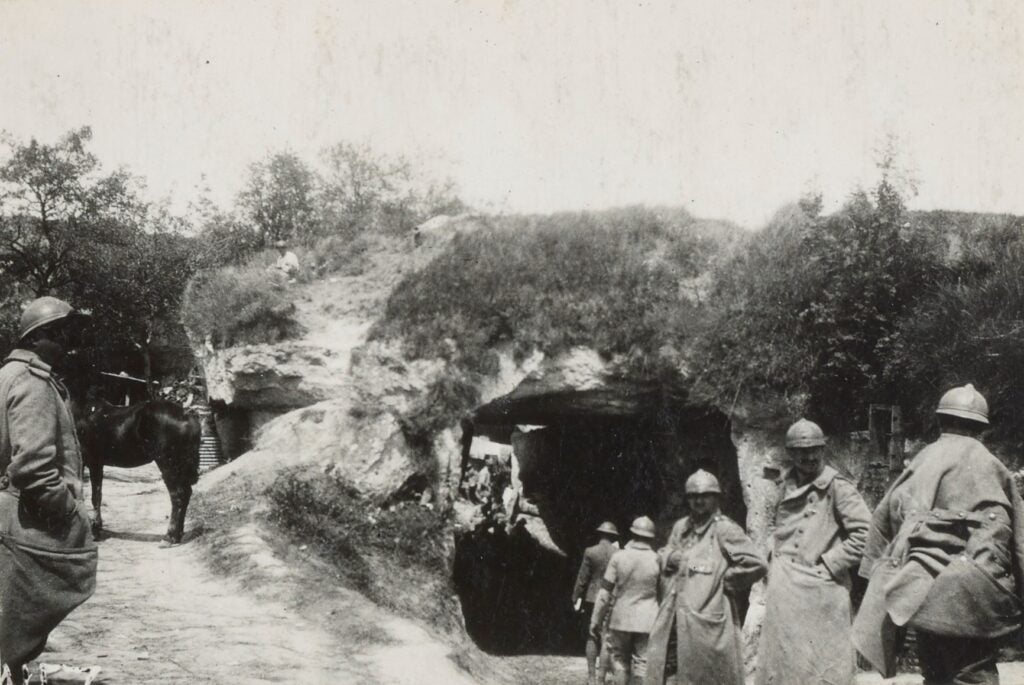
“Comfortable type of a dugout used by the French troops in a heavily shelled district.”
The accompanying 370th Infantry Regiment, on permanent loan from the American Expeditionary Forces, was significantly less desensitized. They, like the other regiments of the 93rd Division, had been fully-integrated into the French Army. They fought with French rifles, wore French helmets, and ate French rations. Virtually all of their equipment, save for the shirts on their backs and the dollars in their pockets, was French. Their French compatriots trained them in French shock-tactics, and tasked them with guarding and repairing French trenches. Though the men of the 370th Infantry Regiment lacked the experience of the venerable poilus that surrounded them, they were expected to fight just as hard as these French veterans, if not more so. Despite the odds stacked against them, these American soldiers soon proved their worth to the French, though their American commanders were substantially more difficult to please.
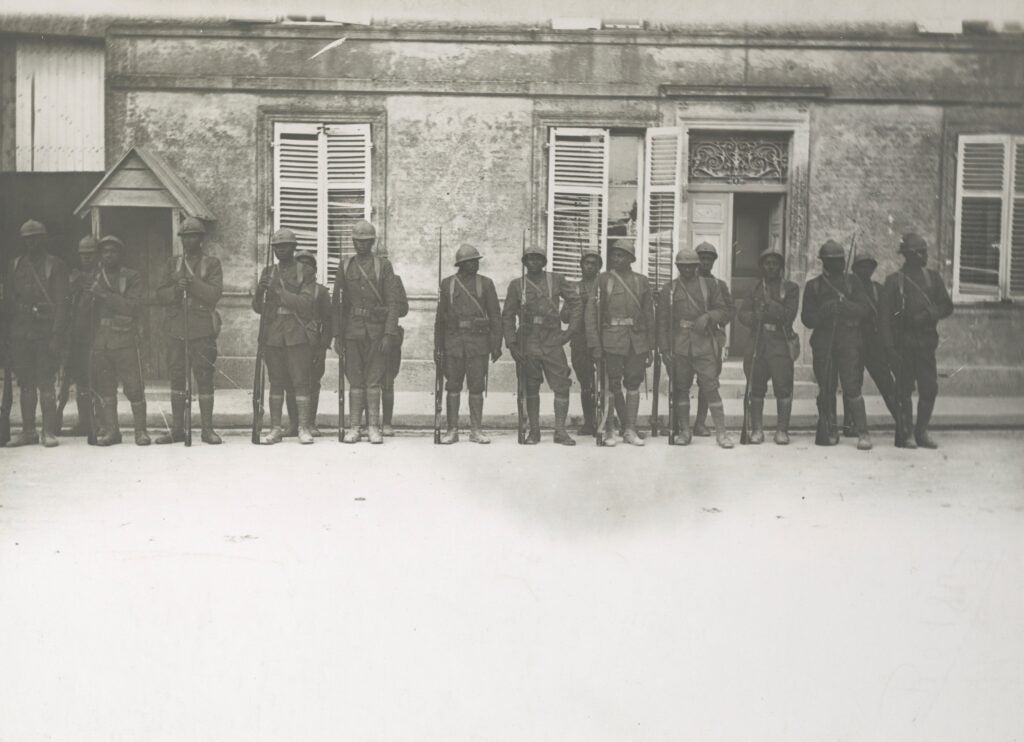
“Members of the 93rd Division stand in front of the barracks in France, 1918.”
Companies [F], [G], [I], and [L] were the first elements of the 370th Infantry Regiment to be brought to the frontline trenches. Here, they joined the French in the assault on Mont des Singes and the woods East of Moisy Ferme, weathered German machine-gun and artillery fire, and launched patrols into no-man’s-land. Sergeant Robert Barnes, of [L] Company, undertook one such patrol, the purpose of which seems to have been to reconnoiter German positions north of the Oise-Aisne Canal in preparation for the next phase of the 59th Division’s operation. However, Sergeant Barnes’ mission came frightfully close to being cut short when, on 19 September, 1918, he was hit in his right side by a German bullet. Though other members of his patrol expressed great concern for his safety and well-being, Barnes made clear his intent to see this mission through to completion.
20 September 1918:
Orders from the French came on 20 September for the 59th Division to halt their offensive on Mont des Singes. The division assumed a defensive disposition on a front running south from the Oise-Aisne Canal, through the Champ Vailly, and on into the wooded hills East of Vauxailon. The companies of the 370th Regiment were quartered at farms and caves on, in, and around the Antioche Plateau, were they were tasked with performing maintenance and repairs on the French defensive works nearest their positions. Companies [F], [G], [I], and [L] remained at the front, but would be relieved on the following day. The German guns continued to hammer the French and American forces.
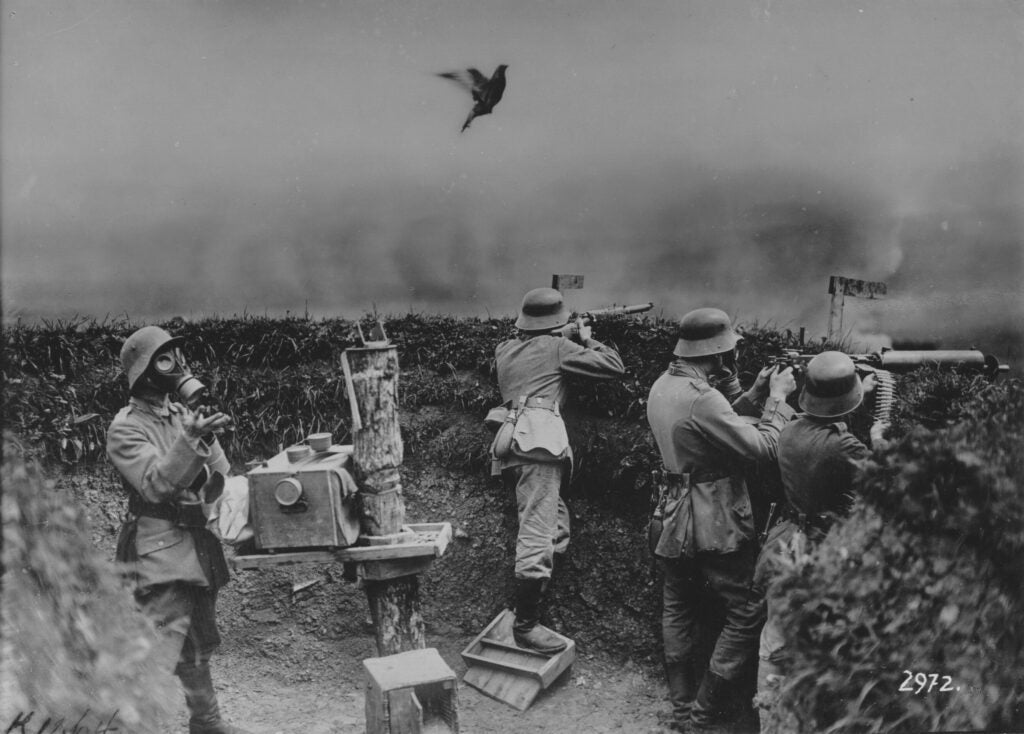
German forward machine-gun nest.
Meanwhile, Sergeant Barnes’ patrol was still deep in no-man’s-land. Though the ruined foliage and craters of the Bois de Mortier provided some concealment from anxious German lookouts, close encounters with enemy sentries and machine-gun nests remained a great concern. Sergeant Barnes knew this better than most, as he possessed a painful reminder of the damage that their guns could inflict. Regardless, he pushed forward. But, as the day wore on, his enthusiasm began to wane. It became clear to both him and his men that, despite his insistence otherwise, his wound was much more severe than he was willing to admit. With their mission so close to completion, however, Sergeant Barnes remained steadfast.
21 September 1918:
On 21 September, Barnes’ time had run out. Light-headed, off-balance, and struggling to focus, he was clearly not fit to continue the mission. With great assistance from the men of his patrol, Sergeant Barnes and his group withdrew from the conflict area, crossed the Oise-Aisne Canal, and made their way back to Company [L]’s headquarters at Tincelle Farm, a distance of nearly 3 miles from their forward position. However, this withdrawal did not mean that Barnes and his men had failed – on the contrary, they had secured vital information on enemy positions in and around the Bois de Mortier, which Sergeant Barnes, in one last show of strength, personally made sure was delivered to his commanding officer by a member of his patrol. Only once the intelligence that his patrol had struggled to obtain was transferred did Sergeant Barnes finally consent to medical treatment.
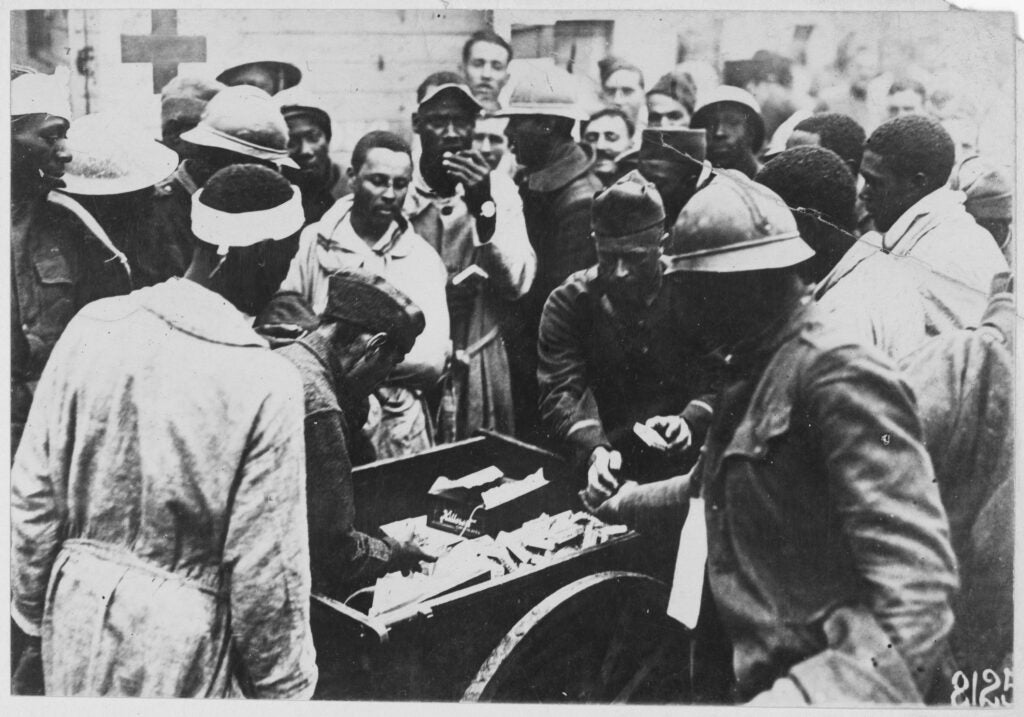
“American Red Cross workers distribute chocolate, cigarettes, and other items to wounded soldiers of the 93rd Division at the American Red Cross Hospital No. 5 in Auteuil, France.”
For his extraordinary heroism in action, Sergeant Robert Barnes was awarded the Distinguished Service Cross on December 6, 1918, under General Orders No. 37, published in 1919.
Later Life (Post-War): Includes post-war education, occupation, marriage(s) and/or children, location and date of death
Robert married Florence Wheeler (1895-1966) on 9 March, 1919 in Chicago, Illinois. Robert and Florence had no children and divorced sometime between 1920-1930; Robert never remarried. Robert died on 27 April, 1943 of an unknown cause in Chicago, Illinois, and is buried in Danville National Cemetery, Danville, Illinois.