Jack Herschkowitz
Jack Herschkowitz’s Personal Narrative was derived from information found in public records, military personnel files, and local/state historical association materials. Please note that the Robb Centre never fully closes the book on our servicemembers; as new information becomes available, narratives will be updated to appropriately represent the life story of each veteran.
Please contact the Robb Centre for further clarification or questions regarding content or materials.
Military Honor(s):
Distinguished Service Cross
Citation: The Distinguished Service Cross is presented to Jack Herschkowitz, Private, U.S. Army, for extraordinary heroism in action near Binarville, France, September 29, 1918. In order to obtain ammunition and rations, Private Herschkowitz, with another soldier, accompanied an officer in an effort to reestablish communication between battalion and regimental headquarters. They were attacked by a small party of Germans, but drove them off, killing one. When night came they crawled unknowingly into the center of a German camp, where they lay for three hours undetected. Finally discovered, they made a dash to escape. In order to protect the officer, Private Herschkowitz deliberately drew the enemy fire to himself, allowing the officer to escape. Private Herschkowitz succeeded in getting through and delivering his message the next morning.
Croix de Guerre with Bronze Palm
Medaille Militaire 3R
Life & Service
- Birth: 21 December 1890, Iasi, Romania
- Place of Residence: Brooklyn, NY, United States
- Race/Ethnicity: Jewish American
- Death: 26 August 1985 New York, NY, United States
- Branch: Army
- Military Rank: Private
- Company: [C]
- Infantry Regiment: 308th
- Division: 77th
Jack Herschkowitz was born on 25 December 1889 (alternate dates of birth include 25 July 1891; 25 February 1891; 24 December 1890; 27 December 1889; 1 December 1889) in Iaşi, Iaşi, Romania to Anna Lowenthal (1860-1936) and Samuel Joseph Herschkowitz (1860-1928). Herschkowitz was the fourth of five children; Bessie (1882-1968), Herman (1882-1961), Sarah (1887-1992), and Ida (1896-2001). The family emigrated to the U.S. on or around July of 1905, sailing from Antwerp, Belgium aboard the vessel Zeeland.
The family settled in Manhattan; Herschkowitz and his siblings lived with their parents on Eldrige Street for an unknown number of years. Herschkowitz worked as a foreman for a suspender factory, later, as a salesman.
Herschkowitz enlisted in the U.S. Army on 20 September 1917 in New York; he was assigned as a Private to Co. C, 308th Infantry Regiment, 77th Division. Pvt Herschkowitz and Co. C left New York on 6 April 1918 aboard the U.S. Army Transport Ship Lapland.
Herschkowitz was promoted to Private First Class on 1 July 1918.
Pvt FC Herschkowitz received the Distinguished Service Cross for his actions on 29 September 1918 near Binarville, France;
“The President of the United States of America, authorized by Act of Congress, July 9, 1918, takes pleasure in presenting the Distinguished Service Cross to Private Jack Herschkowitz (ASN: 1708138), United States Army, for extraordinary heroism in action while serving with Company C, 308th Infantry Regiment, 77th Division, A.E.F., near Binarville, France, 29 September 1918. In order to obtain ammunition and rations, Private Herschkowitz, with another soldier, accompanied an officer in an effort to reestablish communication between battalion and regimental headquarters. They were attacked by a small party of Germans, but drove them off, killing one. When night came they crawled unknowingly into the center of a German camp, where they lay for three hours undetected. Finally discovered, they made a dash to escape. In order to protect the officer, Private Herschkowitz deliberately drew the enemy fire to himself, allowing the officer to escape. Private Herschkowitz succeeded in getting through and delivering his message the next morning.”
“As a soldier in World War I, Mr. Herschkowitz was one of the soldiers who managed to carry word of the desperate need for reinforcements to stage a counterattack to save what was left of the ‘Lost Battalion’ in France in October, 1918. German forces had completely encircled units of the U.S. Army 77th Division in the Argonne Forest. The Americans refused to surrender despite heavy casualties. Mr. Herschkowitz and several others volunteered to try to get through enemy lines to reach U.S. headquarters. It took five days for the reinforcements to break through German lines, but they finally succeeded and freed the battalion.
For his feat, which involved crawling almost two miles through German-controlled terrain and killing a German soldier who spotted him, Mr. Herschkowitz was awarded the Distinguished Service Cross, this nation’s second-highest military decoration.”
Pvt FC Herschkowitz also received the French Military Medal and French Croix de Guerre with Palm, citations unknown.
“A few hours before the America left Brest, Lieutenant Colonel Maurice Laurent, of the French Army, went aboard and announced that he had been ordered to bestow the Croix de Guerre upon three men of the 308th Infantry for gallantry in action. The decorations were for Major McMurtry, Sergeant Benjamin Kaufman and Private Jack Herschkowitz.”
Pvt FC Herschkowitz and Co. C left Brest, France on 19 April 1919 aboard the U.S. Army Transport Ship America, arriving in Hoboken, New Jersey and travelling on to Camp Mills. Herschkowitz was Honorably Discharged on 9 May 1919.
Upon his return home, Herschkowitz lived with his parents and siblings on Houston Street in Manhattan, working as a salesman for a wholesale grocer. In 1923, Herschkowitz married Sadye Tubachinick (1892-1989) in New York; the couple had two children, Phyllis (1924-) and Lois (1928-2022). The family resided in the Bronx into the mid-1920s, in the 1930s, at 1229 East 7th St., Brooklyn. By this point, Herschkowitz was the proprietor of a wholesale grocery business, potentially operating at 41 N. Moore St. in New York. In the 1940s-1950s, the family lived at 1507 East 7th St.
Herschkowitz was active in local organizations, including the Good Neighbor League, Avenue N Jewish Center in Brooklyn, and Great Neck Synagogue. He continued to operate his wholesale grocery business into the mid-1980s, retiring at 91 years old. Herschkowitz died at North Shore University Hospital in Manhasset, Long Island, New York on 26 August 1985; he is buried at Mount Ararat Cemetery, East Farmingdale, New York.
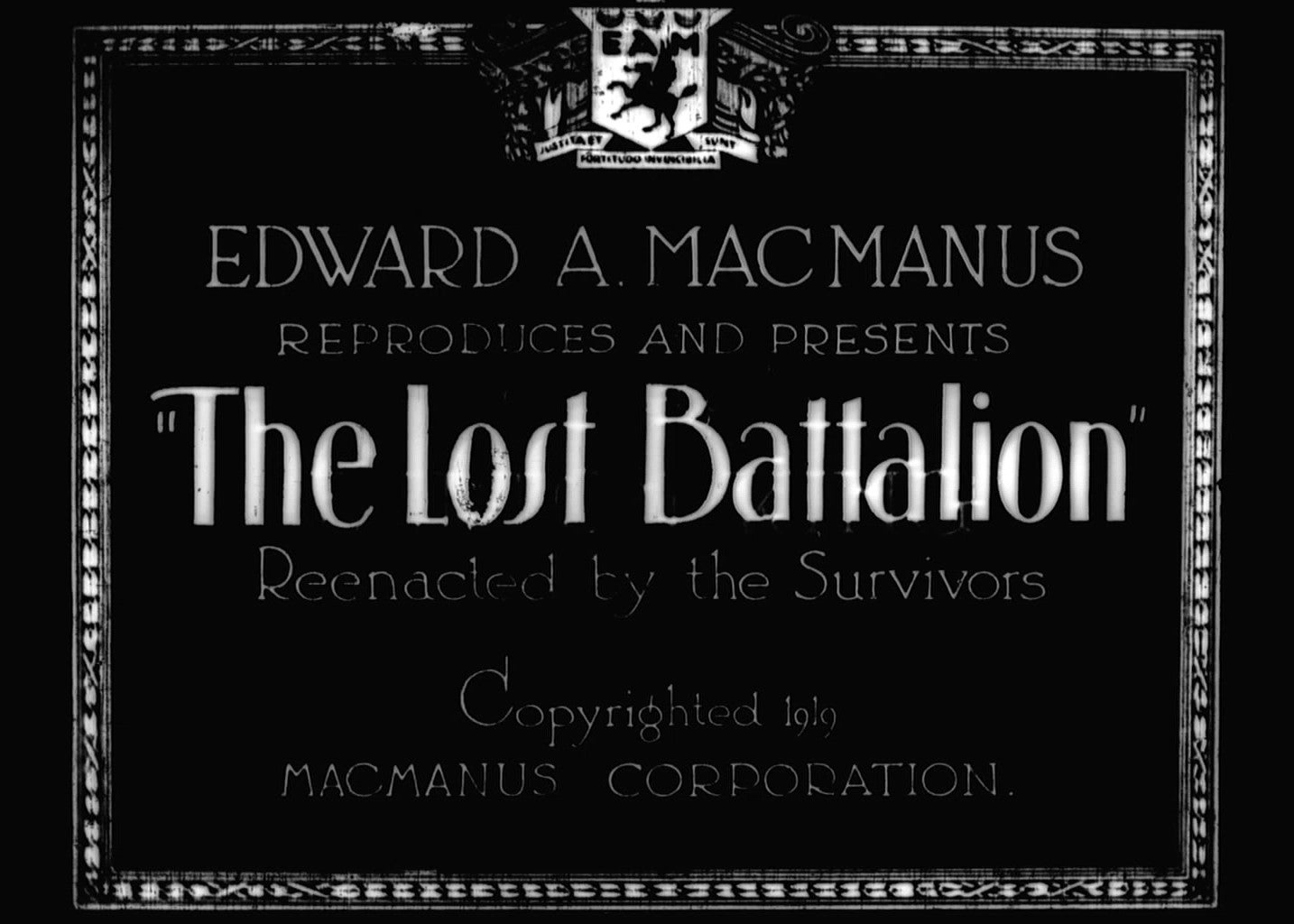
Featured in The Lost Battalion, 1919
Based on the experiences of soldiers in the American 77th Infantry Division, about 550 of whom were isolated and surrounded by the Germans during the Battle of the Argonne in World War I. The men suffered from thirst, hunger, and heavy losses, but refused to surrender. As more men were killed and captured, carrier pigeons became the only method of communicating with headquarters. Coming under friendly fire, the men were saved by a pigeon named Cher Ami, who was able to deliver a message to stop the barrage. After five days, and several unsuccessful rescue attempts, the remaining men were finally rescued. Five participants received the Congressional Medal of Honor, and others received the Distinguished Service Cross. The fictional part of the story precedes and follows the battle scenes, showing the men in civilian life and in training, and the survivors coming home to their loved ones. The fictional characters also appear in the battle scenes along with some of the actual participants.
Digital Id: https://hdl.loc.gov/loc.mbrsmi/ntscrm.00007929
The Lost Battalion, 1919