Norman Frank Henry
Norman Frank Henry’s Personal Narrative was derived from information found in public records, military personnel files, and local/state historical association materials. Please note that the Robb Centre never fully closes the book on our servicemembers; as new information becomes available, narratives will be updated to appropriately represent the life story of each veteran.
Please contact the Robb Centre for further clarification or questions regarding content or materials.
Military Honor(s):
Distinguished Service Cross
Citation: The President of the United States of America, authorized by Act of Congress, July 9, 1918, takes pleasure in presenting the Distinguished Service Cross to Sergeant Norman Henry (ASN: 1401525), United States Army, for extraordinary heroism in action while serving with Machine-Gun Company, 370th Infantry Regiment, 93d Division, A.E.F., near Ferme de la Riviere, France, 30 September 1918. While leading his squad under heavy fire, Sergeant Henry displayed great bravery and coolness by repairing a damaged gun under direct enemy observation. He proved of valuable assistance to the one remaining officer of his company in assembling the scattered units of his company after they had reached their objective.
Croix de Guerre with Bronze Star 24 November 1918
Citation: French Croix de Guerre with Bronze Star, under Order No. 62, dated Nov. 24, 1918, for act on Sept. 30, 1918
Life & Service
- Birth: 21 January 1900, Jersey City, NJ, United States
- Place of Residence:
- Race/Ethnicity: African American
- Death: 20 October 1929 Milwaukee, WI, United States
- Branch: Army
- Military Rank: Sergeant
- Company: [MG]
- Infantry Regiment: 370th
- Division: 93rd
Norman Frank Henry was born to Charles Adolphus (1865-1950) and Gertrude Betty Frank (1875-1919) on January 21, 1900 in Jersey City, New Jersey. Norman was the third of four children, half-brother to Bettina Rosamund (1891-1979) through Charles’ first wife Ida (1864-1899), and full brother to Senora (1896-1962) and Ruth (1902-?). Norman attended school up to the eighth grade; he left home at age fourteen to travel the country, working as a butcher and taking automobile classes at night to become a chauffeur.
Norman enlisted in the United States Army on July 25, 1917 at Camp Grant, Illinois; he trained at Camp Logan, Texas, and Camp Stewart, Virginia. Private Henry and his Company arrived in Brest, France in April of 1918. Then-Sergeant Henry received the Distinguished Service Cross for his actions on September 30, 1918 near Firme de la Riviere, France;
“The President of the United States of America, authorized by Act of Congress, July 9, 1918, takes pleasure in presenting the Distinguished Service Cross to Sergeant Norman Henry (ASN: 1401525), United States Army, for extraordinary heroism in action while serving with Machine-Gun Company, 370th Infantry Regiment, 93d Division, A.E.F., near Ferme de la Riviere, France, 30 September 1918. While leading his squad under heavy fire, Sergeant Henry displayed great bravery and coolness by repairing a damaged gun under direct enemy observation. He proved of valuable assistance to the one remaining officer of his company in assembling the scattered units of his company after they had reached their objective”. Awarded DSC by CG, AEF, Dec. 6, 1918. Published in G.O. No. 37, W.D., 1919.
Sergeant Henry also received the French Croix de Guerre with Bronze Star, under Order No. 62, dated Nov. 24, 1918, for act on Sept. 30, 1918. A victim of poisonous gas inhalation, Sgt. Henry did not seek hospitalization before returning to the United States. Sgt. Henry and his company left Brest, France on February 2, 1919 and landed in New York, New York on February 9. Sgt. Henry was Honorably Discharged at Camp Grant, Illinois on February 24, 1919.
After his discharge, Norman worked as an electrician, plumber, and returned, for a short time, to chauffeuring between 1919 and 1925. Norman married Undine Margaret Johnson on March 11, 1920 in Chicago, Illinois, with her, having two children; Charles Adolphus (1921-2003) and Adelaide Bella (1922-2016). The Henrys separated in 1922; around this time, Norman began experiencing epilepsy-like symptoms, and became unable to hold a consistent occupation due to regular instances of incapacitation and exhaustion. Norman lived with his father, Charles, in between hospitalizations, and attempted to complete vocational training, believing that his previous experience as a chauffeur would no longer be feasible, “Can’t trust [his] nerves to drive in crowd. Asks for reconsideration of case and training in line of less responsibility”. Norman continued to move around the country with various labor jobs until becoming sick with an unknown illness, leading to admission at the National Veterans Home in Milwaukee, Wisconsin in the late 1920s.
Norman died of Lobar Pneumonia (unknown greater cause, potentially undiagnosed Tuberculosis) on October 20, 1929 in Milwaukee. Norman is buried at Wood National Cemetery in Milwaukee, Wisconsin. Mrs. Henry married Samuel Bell in 1937, and died in 1997, outliving her first husband by seventy years.
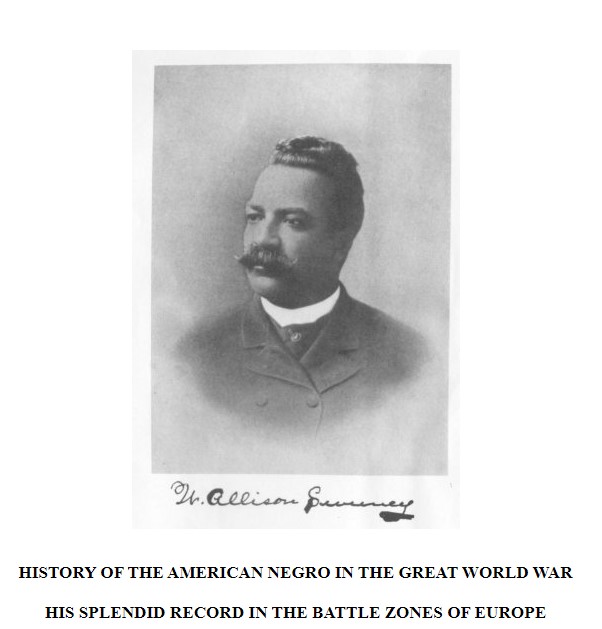
Excerpt from W. Allison Sweeney's History of the American Negro in the Great World War
“Sergt. Norman Henry, 5127 Dearborn St., Chicago, attached to the 3d Machine Gun Company, 370th Infantry, won the Croix de Guerre and Distinguished Service Cross. It was in the Soissons sector September 30 in the first rush on the Hindenburg line.
All of the officers and men fell under a heavy machine gun barrage except two squads of which Sergeant Henry was left in command. They took two German dugouts and were cut off from their own line without food. They held the Germans off with one machine gun for three days. Often the gun became jammed, but they would take it apart and fix it before the enemy could get to them.”